The Girl from Hockley

‘The Girl from Hockley’, Kathleen Dayus, Published by Virago in 2006.  Paralleling many of the issues we have found in researching family experiences in the early twentieth century, this edition of Kathleen Dayus’ life history is a compelling read.

Kathleen Dayus (nee Greenhill) was born in Hockley in 1903 into a large family living in a three storey, back-to-back house.  Detailed remembrances of her early life paint a vivid picture of a harsh existence – lack of food and heating, poor clothing and parish relief.  Male unemployment was commonplace and any opportunities for women to gain employment were often poorly paid.

As Kathleen approached puberty she had scant knowledge of the ‘facts of life’ and her first direct exposure to childbirth (a friend’s mother) ended tragically in the death of mother and child.

Kathleen married her first husband at 18 and had five children before the death of her husband when she herself was barely 30.  Her experience of life in Hockley with several children repeated many of the elements that had been present in her own young life.  Forced into work to support the family, as both her father and husband were out of work, Kathleen’s youngsters were looked after by her mother. Once again the family was interviewed by the ‘welfare’ to justify any financial support.

The book reveals Kathleen’s woeful ignorance as regards contraception with no ‘precautions’ taken until after the birth of her fifth child.  The subject of sex was completely surrounded by ‘ignorance, myth and misunderstanding’ throughout the working-class community.

This detailed story continues to record the difficult decisions Kathleen had to make with regard to her children before she was able to establish a settled home for them once again.

Alison Smith, Project Researcher

Choosing to Challenge

The theme of International Women’s Day 2021 is #ChooseToChallenge so today we are highlighting the stories of women we have researched and written about during the course of our Born in Birmingham project over the last couple of years. Some of them were well-known in their field or still remembered here in Birmingham; others have been long forgotten or only remembered by their families. But all of them in their own way chose to challenge the role of women and what may have been expected from them, and in so doing helped pave the way for those who followed in their footsteps.

We’ve featured several women from the medical professions which is not surprising given part of our research has been into maternity services in Birmingham during the 1914-1924 period. These included the stories of two contrasting midwives : Hannah Armishaw, an old school midwife with little or no formal training who was allowed to join the new Central Register of Midwives in 1904 on the basis of, what we would now call, her accredited prior learning having been in practice for a number of years; and Lizzie Keeping, one of the new breed of qualified midwives who had qualifications in nursing and midwifery and moved to Birmingham to further a career. She lived in Balsall Heath for many years with Claire Bement, an Inspector of midwives. Just good friends and colleagues? Or were they choosing to challenge in other ways too?

Dame Hilda Lloyd is remembered for her pioneering work in the field of obstetrics, including establishing Birmingham’s first emergency obstetrical service: the flying squad. Much of her career has been well-documented as she climbed the medical ladder; becoming a lecturer in 1934, professor in 1944 (the first female to achieve a professorship at UoB), and chair of Obstetrics and Gynaecology in 1946. She received  national recognition in 1949 when she was elected as the first female President of a Royal Medical College at the Royal College of Obstetricians and Gynaecologists (RCOG) serving a three year term.  In 1951 she was knighted Dame of the British Empire ‘for her services to her Speciality, College and her University’. Our blog covers some of her lesser known activities in promoting family planning services against much opposition so definitely choosing to challenge!

Several of our volunteer researchers concentrated on infant welfare including the establishment and expansion of Infant Welfare Centres and the role of health visitors.

Profile of an Infant Welfare Lady Superintendent looked at the life and career of Miriam Shewell, a Quaker from Yorkshire who after training as a nurse and midwife was appointed Lady Superintendent of Sparkhill and Greet Maternity and Infant Welfare Centre in 1919. She involved local women in decision making at the Centre, recognising their localised knowledge and experiences. She was well respected in her field and wrote a series of standardised health talks used in welfare centres nationwide.

The Carnegie Infant Welfare Centre was opened in 1923 and considered a centre of excellence. Its first matron was Elizabeth Exell who during WW1 had been a nursing sister with the Women’s Hospital Corps, established by former militant suffragists Flora Murray and Louisa Garrett Anderson. The WHC established two women-run military hospitals in France: the first in Claridge’s Hotel in Paris with the support of the French Red Cross and the second in Wimereux near Boulogne which was sanctioned by the British War Office. Elizabeth continued work with the WHC back in London at the Endell Street Hospital from 1917 before moving to Birmingham to take up work at Pype Hayes Convalescent Hospital and thence to the Carnegie.

The newly established role of infant health visitor was crucial to the tackling high rates of infant mortality in the City alongside that of the IWCs. Their Superintendent Blanche Gardiner in 1914 oversaw the work of responsible for 19 Health Visitors, 5 Infant Health Visitors, 10 TB Visitors, 1 Inspector of Midwives and 2 Inspectors under the Factory and Workshop Act. By 1924 her role focused entirely on maternity and child welfare and she had responsibility for 61 Health Visitors and Infant Health Visitors who dealt only with infants or still births occurring outside the Infant Welfare Centre boundaries.

This highlights just a few of the women in Birmingham who deserve commemoration as “Choosing to Challenge” on International Women’s Day. Each in their own way helped provide crucial maternity and infant welfare services to hundreds of women and were pioneers in their fields, constantly challenging the status quo and seeking improvements in the way services were developed and delivered. #ChoosetoChallenge

Liz Palmer

Project Co-ordinator

A Handwritten Mother’s Notebook – Part 1

One of the hardest things to find, during the course of the Born in Birmingham, project has been contemporary accounts of early babyhood and the experience of being a mother. There are some later reminiscences, such as the autobiographical memoirs by writers such as Kathleen Dayus, which are extremely valuable but we were constantly on the look out for any material written at the time. Of course the archives are not the only repositories of written material; much of it lurks at backs of drawers, or in dusty boxes in lofts just waiting for someone to take notice and hopefully not discard it in the nearest bin. Such items find their way sometimes after house clearances to auctions and of course these days to online auctions. So right at the start I set up some searches on Ebay (other online sites are of course available!) in the hope of finding relevant material for the project.

Eventually an interesting item caught my eye – a ‘handwritten mother’s notebook’. From the description I could tell that it was from a slightly earlier era than the 1914-24 period of our project. But the seller was situated not too far from Birmingham so there was some hope that there may at least be some Brummie connections. So a purchase was made.

It’s a slight volume – just 10cm x 16cm -and although it contains 84 pages approximately half of them are blank.

The first page looked promising, headed Baby Management it listed the items that the young mother had put together for her baby’s layette. After that the entries consist initially of either brief snippets of advice about certain aspects of baby care, which seem aimed at giving advice to the reader, interspersed with equally brief notes about the particular experiences of this young mother and her baby, Marion. It is difficult to tell whether it was written as she went along or if the notes were written up much later afterwards; in either case it’s not clear whether they are aimed at a 3rd party or simply as her own aide memoire. Later entries include some elements about Marion’s education and also about their annual vacations plus some general medical advice. I suppose it is a very simple form of commonplace book.

Before compiling a complete transcription I undertook some detective work to see if there were sufficient clues to identify the writer – and the infant Marion – and hopefully find some link to Birmingham. In the latter endeavour I was to fail because, although scant, there were just enough genealogical details within the notebook to definitely identify the author.

The name Kate Wright and year 1899 were written on the inside front cover and on page 2, at the start of a sentence about Marion’s constipation (!), it revealed her date of birth as 12th July 1898. So with just those key pieces of information, and the convenient fact that Marion didn’t marry until late in life, I was able to easily find her in 1939 National Register (and corroborate with other records) under her maiden name of Marion Wright but overwritten with her future married name of Forsell as she appears to have married her co-boarder John T Forsell (but not until 1944). So in Sept 1939 she was a physical training instructor living in a house called Winkadale in Billesdon, Leicestershire.

Billesdon is just 10 miles north of Great Bowden, near Market Harborough and it was there that Marion was born, the only daughter of grazier Jeffrey Wright and his wife Kate (nee Corby). So not quite the urban born child of Brummies that I had been hoping for!

In the next two parts of this blog I will write more about the content and advice from within this notebook as it does contain some interesting period details about babycare some of which have still been prevalent 15 to 20 years later; and some ideas which hopefully had died out! To whet your appetite here is the list of items that formed Marion’s layette:

First page of a handwritten mother's notebook started in 1899

Liz Palmer

Born in Birmingham Project Co-ordinator

Birmingham Children of War

Long before the idea for the Born in Birmingham project the Friends of Birmingham Archives and Heritage (FoBAH) ran another project researching the experiences of children living in Birmingham during the first world war. If you haven’t already come across it the blog is still available to read here https://birminghamchildrenofwarblog.wordpress.com/ and the resultant summary in the form of a learning guide is now available to read online here: https://issuu.com/fobah/docs/birmingham_children_of_war_learning_guide_2017

We are currently just waiting for a couple of copyright clearances on images for the Born in Birmingham learning guide and associated exhibition. But hopefully will be able to share with you soon.

Liz Palmer

Purchasing the all-important equipment and products for a new born

Within the local monthly magazine volumes of Edgbastonia (L91.3/34824), circulating in Edgbaston and the West End suburbs of Birmingham, there can be found many trade recommendations and illustrations to steer shoppers to the town and to the neighbouring retailers in Edgbaston.

Located in High Street, City and Midlands Arcades, The Grand Louvre, was renowned for the helpfulness of its staff and the great choice of essentials and paraphernalia for a new born.

“There are, to begin with, the shrines for His and Her safe sheltering during sleeping hours – the most adorable cots, with charms of daintiness as well as of cheapness to recommend them.  And, then, the wonder of the first wee garments of all – the little shirts of the finest and softest imaginable weaving of silk and wool; the long petticoats of down-soft flannel, all edged with a scalloped hand-embroidery, the broidered beauty of the robes, and the fascination of the nightdresses.”  Edgbastonia (L91.3/34824), Vol 40, 1920.

As well, in City Arcades, was located Stanley’s; a well-known business in the clothing requirements for boys and girls.

“… a world of inspiration waits a visitor to the children’s salon at this establishment, for Stanley’s have a foremost place as authorities on all matters appertaining to the clothing and dressing of children.  Bearing this fact well in mind, mothers in quest of clothing for small boys and girls should most assuredly wend their way in the direction of Stanley’s, who may now claim to have bought the art of cutting and making the small garments they supply, up to the state of perfection.”

Moreover, to win the approval from the juvenile visitors to Stanley’s, the toys and games department held a great fascination,

“There are dollies of all descriptions, peasant dolls, dolls in early Victorian costume, and the most entertaining Esquimeux dolls habited in brown plush.  Then the animals!  Departures for the most part from the hard, wooden type, they are the quaint plush-covered variety; soft springy to play with, and having the special advantages that it being impossible for the smallest or most exuberant spirited child to hurt him or herself with any of them.” Edgbastonia (L91.3/34824), Vol 36, 1917

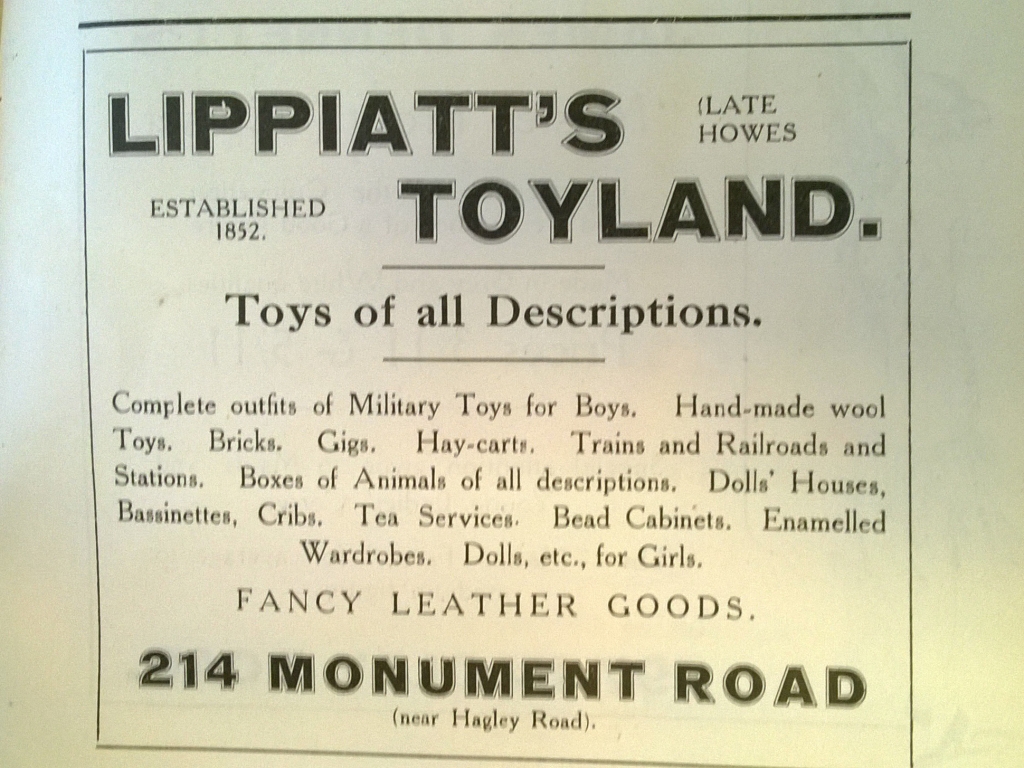
At Lippiatt’s Toyland, 214 Monument Road, (near Hagley Road) children could find much to charm, to thrill, and to delight them.  New and old favourites in November 1916, included,

“The English Tommy and Jack Tar are well to the fore, while smart gentlemen indeed are the English staff officers and naval officers.  The signs of the times again are brought into notable evidence in mechanical Red Cross ambulance and armoured motor car. For the little girlies, whose warlike instincts are not quite so fully developed as in the case with small boys just at present, Lippiatt’s are providing, as usual, the sweetest, daintiest things in dolls and doll-land delights.” Edgbastonia (L91.3/34824), Vol 36, 1916

Anne Hornsby

Dame Hilda Lloyd – Birmingham pioneer

Blue Plaque at University of Birmingham

Although much of the Born in Birmingham project has focused on the activities of midwives and health visitors, and their role in improving maternal and infant welfare, we would be very remiss if we didn’t also look at the work of any of Birmingham’s obstetricians and gynaecologists. And one of the leading lights in these fields, both locally and nationally was Dame Hilda Lloyd.

Hilda Lloyd, was born Hilda Nora Shufflebotham on 11 August 1891, the third daughter of high-class grocer John Shufflebotham and his second wife, Emma. The family were living at 170 Moseley Road in Balsall Heath but shortly afterwards moved to Chantry Road, Moseley and then to ‘The Firs’ at Moor Green. Hilda attended King Edward VI High School for Girls in Edgbaston and from there opted to remain in Birmingham to begin medical training at the University of Birmingham from 1910  graduating with a BSc and then MB, CHB by 1916. Hilda would undoubtedly have been a high achiever in any circumstances but with the absence of many male doctors and surgeons on war duties her gender was less of an impediment that it may have been. She became resident Surgical Officer at the Maternity & Women’s Hospital immediately after graduation and obtained her Fellowship of the Royal College of Surgeons in 1920. Subsequently she was appointed to the consultant staff as the Women’s Hospital.

Much has been written about Hilda’s pioneering work in her field including establishing Birmingham’s first emergency obstetrical service: the flying squad. And much of her career is well-documented too, as she climbed the medical ladder becoming a lecturer in 1934, professor in 1944 (the first female to achieve a professorship at UoB), and chair of Obstetrics and Gynaecology in 1946. She received  national recognition when, in 1949, she was elected as the first female President of a Royal Medical College, at the Royal College of Obstetricians and Gynaecologists (RCOG) serving a three year term.  In 1951 she was knighted Dame of the British Empire ‘for her services to her Speciality, College and her University’.

Less well documented are her involvement from the 1920s with the promotion of birth control and family planning in Birmingham. She was a member of the committee formed to set up the Birmingham Women’s Welfare Centre along with Elizabeth Cadbury and Sir  John Sumner. This first centre opened in Castle Street with the slogan  ‘CHILDREN BY CHOICE, NOT CHANCE’.

Birmingham Daily Gazette - Saturday 17 November 1928
Birmingham Daily Gazette – Saturday 17 November 1928

Hilda continued with her involvement with the Centre and arranged to see women presenting at the Centre with unusual gynaecological conditions at Maternity and Women‟s Hospital.  In 1931 she was a signatory on an open letter to the Gazette protesting against the Maternity & Child Welfare Committee’s decision to take no action to provide birth control advice in cases where further births could be detrimental to a mother’s health although this was to be allowed under the Ministry of Healths Memorandum 153. And the following year she was part of a deputation of women doctors to the Birmingham Public Health Committee to once again urge that birth-control knowledge should be made available at the municipal maternity and child welfare centres.

In March 1938 the Birmingham Daily Gazette’s includes mention of Hilda’s presence at a meeting of the Women’s Welfare Centre held at the home of Edward Mason in Highfield Road, Edgbaston. The speaker was Mrs [Margery?] Spring Rice on the topic of “Birth Control and Race” and she was thanked by Mrs Sargant Florence [Lella Florence – a founder of the Birmingham Family Planning Association]. Both of these women were members of the Eugenics Society and the history of family planning is inextricably linked with this movement. But there are no suggestions that Hilda shared eugenicist views.

Image Copyright: Research and Cultural Collections, University of Birmingham. Permission Sought

In 1930 Hilda had married Bernard Lloyd, a fellow surgeon, and they lived in Edgbaston at 40 Harborne Road. Following Bernard’s sudden death in 1948 she married another surgeon and neighbour, Baron Theodore Rose.

The School of Medicine commissioned a bronze bust of Dame Hilda and its unveiling she was reported as saying:

“What else is there ? By the time one’s been painted in oils, had a bust fashioned, and been made an Emeritus Professor, there’s only one thing to do—slide gracefully away.”

Dame Hilda and her second husband moved to Ross on Wye following their retirements in the early 1950s and indulged their passions for walking and travel. Baron died in 1978 and Hilda spent the last couple of years of her life in Stourbridge where she died 18th July 1982 at the age of ninety.

Liz Palmer

Impact of Improved Sanitation on Infant Welfare

Robert Gould opted to look at wider initiatives to improve sanitation in Birmingham in the years 1914 to 1924 and the impact they had on infant welfare and infant mortality.

Photograph shows children playing by wash houses and latrines in an unidentified courtyard in Bagot Street taken c.1910 WPS/WK/B11/AO/1609

Sanitation and Disinfecting interventions made an important contribution to controlling the spread of infections and reducing mortality particularly for infants within the back to back housing and poverty-stricken inner council wards of Birmingham. These interventions when working together with the many other quality of life improvement activities (for example: improving housing conditions, child health clinics, Maternity services, educating people in good hygiene practice and the dangers of cross infection together with improving general medical support and facilities), created a synergy that was gradually improving conditions and outcomes for babies, infants and people in general.

Reducing mortality and improving living and working conditions was not down to improving one area of concern but the combination of actions taking place over time, as indicated above.

The annual number of interventions and items dealt with under sanitation and disinfections are detailed in the charts and tables below. During the war years due to number of men being enlisted for military service overall intervention numbers reduced markedly, however mortality continued to fall (except for the 1918 influenza outbreak), due to the synergy effect of the many other improvements being made.

An example list of sanitation interventions and numbers are shown in the table and chart below. (Reference Medical Officer Health (MOH) Reports 1912 to 1924 sanitation sections).

Example of Defects for which Notices were Served
Visits Paid by Inspectors and Notices Served – 1912 to 1924 [Red Line Denotes War Years]

An example list of disinfecting interventions and numbers are shown in the table and chart below. House/bedding and clothing disinfections post infectious disease. (Reference Birmingham Medical Officer Health Reports 1912 to 1924 disinfection sections).

Number of Items Disinfected – 1912 to 1924 [Red line denotes War Years]

To support what has been highlighted in this commentary, below is an extract from the 1924 Medical Officers Report.

Medical Officer of Health report for Birmingham 1924 – Introduction

“By far the larger part of all sickness is preventable. To a very great extent it can only be prevented by the individual knowing how to live a healthy life. It is, therefore, an important function and duty of the Public Health Authority to do everything in their power to inform the community how to live under healthy conditions. All indications point to the diffusion of this knowledge amongst the people as the chief cause of the better health which is now enjoyed, as compared with that in previous years.”

Sanitation and disinfecting interventions were seen and experienced by people thereby reinforcing the message on ground about cleanliness and reducing cross infections; that was one of factors keeping youngsters alive and well.

Notwithstanding the above sanitation and disinfection interventions, in every Medical Officer’s Report for the time period 1914 to 1924 major concerns were highlighted about the poor quality of housing and overcrowding, particularly for the inner council wards, particularly when compared  with the associated higher infant mortality and disease incidence of the middle and outer council wards.

Born and being brought up in Birmingham during 1914 to 1924 was certainly challenging but with a multi-intervention approach and in spite of everything the prospects for infants (and Adults) were gradually improving.

Robert Gould

Housewifery Tuition

Project volunteers recently spent a couple of interesting afternoons at Selly Manor looking through early Bournville Works Magazines (BWM).  These magazines were produced by the Cadbury Company from 1902-1968 and contain a myriad of articles on a wide range of company and local matters.

Anne and Alison were hoping to find some commentary in these detailed volumes on the teaching of Mothercraft (or similar) at the nearby Bournville Primary Schools.  Opened in 1906 by the Kings Norton and Northfield Urban District Council, these schools were built on land given by the Cadbury family.  The school for older children (now the Junior School) contained a large basement classroom with a raised seating area and several small sinks; facilities which may have been intended for domestic science lessons.  A nearby house was used to provide similar ‘real life’ tuition.

Thus, both were excited to find mention of ‘the cottage at No. 10 Thorn Road which was experimentally equipped by the firm … for the teaching of Housewifery has been taken over by the Kings Norton and Northfield Higher Education Committee’.

Miss S M Vidal was teacher of the Housewifery at the cottage and here is a photograph of such activity with a group of girls gathered around a kitchen table.

Housewifery Tuition – The photograph illustrates a typical scene at No. 10 Thorn Road, Bournville, where in the mornings and evenings, classes were held in Housewifery. The teacher is Miss S. M. Vidal. ((BWM December 1910)
A scene from the Housewifery College, Thorn Road, where girls attend a course in the subject. (BWM November 1923)

(Anne and Alison are hopeful that, post Covid, they will be able to look at the school’s log books in order to trace other mentions of household pursuits. )

On a similar line, an article in the BWM from December 1910, described the ‘Family Budget Competition’ held on the Bournville site by Cadbury Bros – weekly housekeeping accounts were required for a family of four (husband, wife and two children under six years of age) with an income of 26s a week. The accompanying article, written by Miss S M Vidal, describes the competition and the discussions that had stemmed from it –

· ’Penny in the slot’ electricity not economical

· Keeping a household account is troublesome but most necessary

· See what you buy; don’t order from the door

· Tobacco couldn’t be accommodated on such a tight budget!

Finally, and pertinent at this time of year, a surplus amount of cash in the Bournville Workers’ Gift Fund left from WW1 (£1600) was used for a number of gifts to local charities, including the ‘Bournville Cot at the Children’s Hospital’ – ‘the debt owed to the dead should be rendered rather to the living’. BWM January 1921

The Bournville Cot at The Children’s Hospital (BWM January 1921)

Anne Hornsby & Alison Smith

Badges

Birmingham has a long and distinguished history of metalworking and by the end of the Victorian period had developed an international reputation for metal production, making everything from boxes, trinkets and cheap jewellery (known collectively as toys) to guns, pins, pens and buttons.

State Certified Midwife Badge (undated)
Good Hope School of Midwifery
Badge of College of Midwives 1881
Badge of Certified Midwives 1922

Thomas Fattorini Ltd, a well-respected company, established a Birmingham manufacturing base in 1919 and can now be found on Regent Street in the Jewellery Quarter.  They remain renowned designers and manufacturers of bespoke items, including many badges and medals. https://fattorini.co.uk/

The Midwives Act of 1902 required the Central Midwives Board to maintain an employment register of trained midwives and the term ‘midwife’ could now only be used by those individuals certified under the Act.  For details of this Act and its early implementation in Birmingham please see Maggie Brownlow’s blogs from April 2020 https://borninbirmingham.home.blog/blog-feed/

Examples of such badges, recognising the standing of this newly recognised profession and produced by Thomas Fattorini Ltd, can be seen at the beginning of this item and these images are reproduced with the kind permission of Sally Bosleys Badge Shop https://www.sallybosleysbadgeshop.com/

Alison Smith – BiB Project Researcher

Growing out of chaos

Living life differently

Midwives Chronicle: The Heritage Blog of the Royal College of Midwives

Midwifery history from the Royal College of Midwives

Discover WordPress

A daily selection of the best content published on WordPress, collected for you by humans who love to read.

Longreads

Longreads : The best longform stories on the web

WordPress.com News

The latest news on WordPress.com and the WordPress community.

Design a site like this with WordPress.com
Get started